
Buyer: Apartment vs Villa in Costa Blanca North, Total Cost Compared
Property in Costa Blanca North is rarely a simple apartment-versus-villa decision. On paper it looks obvious. Apartments cost less, villas cost more. In practice, it is more layered than that. In several local markets, apartments are not even cheaper on a square metre basis.
In Moraira, average apartment asking prices are currently around €3,601/m², against €3,509/m² for houses. In Dénia the pattern is similar, with apartments at about €3,440/m² and houses at €3,356/m². Benissa shows an even wider gap, with apartments around €3,581/m² and houses around €3,112/m². So the real difference is not always price per square metre.
More often, it is total ticket, taxes, and what it costs to own the property once the keys are in your hand.
If you have ever tried to park near the Port in Jávea on a Friday morning, or found yourself circling Arenal in August for longer than expected, you already know demand here is not abstract. Buyers are comparing lifestyle, yes, but they are also comparing cash required at completion, ongoing costs, and how much financial flexibility they want after the purchase.
In our experience, the buyers leaning towards apartments are often 60-plus international couples looking for a simpler, lock-up-and-leave base in the sun, while villa buyers are more likely to be full or semi-relocators who want privacy, outside space and room to stay longer.
Start with the comparison that matters
To keep this clear, the fairest way to compare an apartment with a villa is to use resale property, not new build. That removes one big distortion, because resale and new-build purchases are taxed differently in Spain.
As of 10 March 2026, a resale purchase in the Comunitat Valenciana generally pays 10% ITP, rising to 11% once the property value goes above €1 million. From 1 June 2026, the general rate drops to 9%, while the 11% rate above €1 million remains. New-build homes are different again, because they are generally bought with 10% VAT, plus AJD, which in Valencia is 1.5% today and falls to 1.4% from 1 June 2026.
That date matters. A buyer who completes on a resale apartment in April 2026 is not in the same tax position as one who completes in June.
A worked example in Jávea
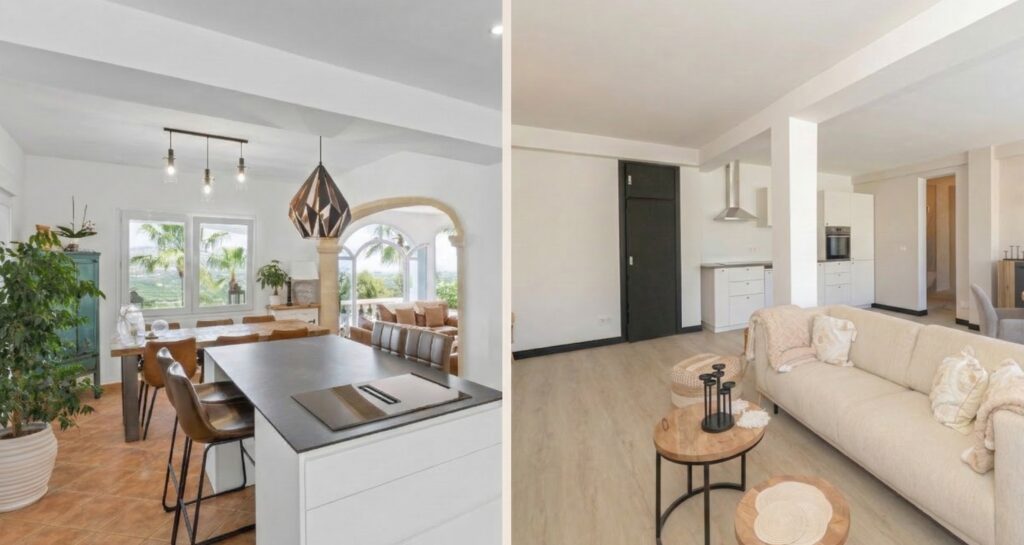
Using current 2026 asking-price data for Xàbia, apartments are averaging €3,472.34/m² and houses €3,599.41/m². That is closer than many buyers expect. But a villa is still normally much more expensive overall, simply because you are buying more built area, more exterior space, and usually more privacy.
So let’s take two realistic examples.
A 95 m² apartment in Jávea, priced at the local apartment average, comes out at roughly €329,872. A 180 m² villa at the local house average comes out at roughly €647,894. Add today’s 10% resale ITP, and those numbers rise to about €362,860 for the apartment and €712,683 for the villa, before notary, registry, legal and mortgage-related costs. If the same resale purchases complete after 1 June 2026, the tax-adjusted figures fall to about €359,561 and €706,204 respectively, again before the other closing costs.
Then come the costs buyers often underestimate. Notary fees on a purchase typically sit around 0.2% to 0.5% of the purchase price, usually around €600 to €875 for the sale deed. Registry costs often run around 0.1% to 0.25%, commonly €400 to €650. A gestoría, if used, is often around €300. None of these numbers will make a villa unaffordable on their own, but they push the real cash required above the headline price very quickly.
And that is before financing. OCU notes that, in most cases, banks still lend only up to around 80% of the property value, which means buyers should expect to bring roughly 20% deposit plus about 10% extra for taxes and purchase costs. In other words, the rule of thumb is still around 30% cash to get to completion. On a villa purchase, that is where the difference becomes very real.
A good local example makes the difference clearer. Take a renovated two-bedroom apartment close to Arenal Beach in Jávea, currently marketed at €325,000, and compare it with a four-bedroom villa in Piver at €1,595,000. Both are recognisably Jávea purchases, but they create very different financial commitments from day one.
The apartment currently attracts €32,500 in transfer tax, while the villa attracts €175,450 because resale purchases above €1 million in the Valencian Community are taxed at 11%. That means the apartment lands at roughly €357,500 before notary and legal costs, while the villa is already at around €1.77 million before those extras are added.
And that is only the purchase stage.
The apartment is more likely to come with predictable community fees and lower day-to-day maintenance, while the villa brings private outdoor space, more independence, and much higher control over the property, but also the cost of pool care, gardens and exterior upkeep. For many buyers, that is where the decision becomes clearer. It is not just about what you buy, but about where you want the cost to sit: upfront, monthly, or in ongoing private maintenance.
The June 2026 tax changes make the contrast slightly sharper rather than softer.
From 1 June 2026, the general Valencian resale ITP rate falls from 10% to 9%, but the 11% rate on purchases above €1 million remains. In practical terms, that means the €325,000 Arenal apartment benefits, with transfer tax falling from €32,500 to €29,250, while the €1.595m Piver villa stays at €175,450 because it remains in the higher bracket.
The AJD reduction from 1.5% to 1.4% only affects new-build purchases, so it does not change this particular comparison. In other words, the June 2026 reforms marginally favour the apartment buyer and leave the villa buyer broadly unchanged.”
What an apartment really costs to own
Apartments usually win on simplicity. The maintenance burden is spread across the building, lifts, communal pool, gardens, lighting and insurance are partly socialised through the community, and for many international buyers that predictability has real value.
That said, apartments are not automatically cheap to hold. Idealista’s 2025 ownership-cost benchmarks put community fees in Spain at around €100 to €110 per month on average, with premium developments going much higher. It also uses about €360 a year as a national IBI benchmark, around €193 a year for home insurance, about €990 a year for electricity, roughly €30 a month for water, and €20 to €40 a month for internet. Based on those benchmark inputs, an apartment can easily land somewhere around €3,300 to €3,700 a year in core running costs before mortgage payments, derramas or any premium community charges.
And that last point matters. A well-run apartment block feels straightforward, until there is a lift replacement, façade work, a problem with the communal pool, or a larger-than-expected derrama. That is often the part buyers overlook.
What changes when you buy a villa
Villas usually feel more expensive, and often they are, but not always in the way people expect. The purchase price is the big jump. The annual holding cost is more variable.
A private pool in Spain typically costs around €600 to €1,200 a year to maintain on average, and if you use a professional service the national benchmark is closer to €80 to €150 a month. On the Costa Blanca itself, entry-level advertised maintenance contracts are currently visible from around €65 a month in the Jávea and Dénia area, and from around €75 a month in Benissa. A pool can also increase insurance costs by around €80 a year, and Idealista notes that it can lift annual IBI by roughly €80 because of the higher cadastral value.
Then there is the garden. National 2026 service-rate guidance puts gardening labour at around €15 to €25+ per hour, while a local Jávea property-services company lists general service labour at €22.50 per hour per person. That means even a modest maintenance routine can become a real annual line item, especially on larger plots around Montgó, Tosalet or the greener villa zones where owners want the place looking right when they arrive.
This is why villas are best understood as variable-cost ownership. You may have no meaningful community fee, or only a modest urbanisation charge, but the private expenses sit with you: pool, garden, exterior painting, drainage, gates, walls, terraces, irrigation, and the occasional surprise. An apartment concentrates more cost into fixed monthly charges. A villa gives you more control, but also more exposure. That is the trade-off.
So which one costs more?
At the point of purchase, the villa almost always costs more in absolute terms. In the Jávea example above, the gap between apartment and villa is already over €318,000 before notary and registry are even added. That is the real cost difference most buyers feel first.
Over time, though, the answer is less tidy. A modern apartment in a good development may come with meaningful monthly community fees, and in luxury schemes those charges can rise far above the Spanish average. A villa may avoid those fixed payments but create more irregular private bills. So if your priority is cost certainty, an apartment usually wins. If your priority is privacy, space and freedom from community rules, a villa may still be the better financial choice for you, even if the annual upkeep is less predictable.
For many buyers in Costa Blanca North, the real question is not “which is cheaper?” It is “where do I want the cost to sit?” Up front, month by month, or in occasional larger maintenance decisions.
The bottom line
In Costa Blanca North, apartment does not always mean budget, and villa does not always mean financially irrational. Apartments can be expensive per square metre, particularly in places like Moraira and Benissa. Villas are usually more expensive in total because they come with more space, more land and more independence. The smartest comparison is not square metres alone. It is purchase price, tax, cash required at closing, and your tolerance for ongoing maintenance.
That is where buyers usually get clearer about what they actually want.
In our experience, this is exactly where buyer priorities start to shift: some realise the apartment gives them the easier, more flexible ownership model they wanted all along, while others decide the extra outlay for a villa is worth it for the space, privacy and longer stays.
Thinking about buying in Jávea or the surrounding area? Speak to Grupo Garcia for clear, local advice on what each type of property really costs.
FAQs
Is an apartment always cheaper to buy than a villa in Costa Blanca North?
Usually in total price, yes, but not always in price per square metre. The more important comparison is total acquisition cost, including transfer tax, legal fees, and the annual cost of ownership after completion.
What ITP rate applies in the Valencian Community from 1 June 2026?
For resale homes, the general ITP rate falls from 10% to 9% from 1 June 2026. The higher 11% rate for properties priced above €1 million remains in place, which means many villas are unaffected by the tax cut while apartments below that threshold may benefit.
Does the June 2026 AJD reduction affect this apartment-versus-villa comparison?
Only if you are comparing new-build homes. AJD applies to purchases that are subject to VAT, typically new builds, and the general AJD rate falls from 1.5% to 1.4% from 1 June 2026. For resale homes, the main tax is ITP, not AJD.
Are villas always more expensive to own than apartments in Costa Blanca North?
Not always in a simple month-to-month sense, but they are usually more expensive overall to maintain. Apartments often come with predictable community fees, while villas tend to bring more private costs such as pool maintenance, garden work, exterior repairs and higher utility use. That means apartments often offer more cost certainty, while villas offer more control and privacy.
Do wider 2026 tax changes matter for high-value buyers as well?
They can. For residents in the Valencian Community, the wealth tax exempt minimum is now €1,000,000, and the June 2026 reforms also introduce a 25% reduction in inheritance and gift tax for certain Group III relatives, such as siblings, uncles, aunts, nieces and nephews. Those points do not usually change the day-one purchase cost, but they may matter in longer-term tax planning.
References
The main official legislation link is:
And the Valencian official gazette version is here:
If you want the consolidated tax law that this amends, use this too:
For a practical tax authority page on ITP/AJD in Valencia: